
Incoterms 2020 Explained | Rules, Costs and Responsibilities
Three letters at the bottom of a sales contract can end up costing more than the freight itself.
So what are Incoterms? They are standard trade terms that define who pays for freight, who bears the risk if the goods are lost or damaged, and who handles customs. A buyer who agrees to CFR thinking everything is covered often discovers, when the vessel arrives, handling and storage charges they had not budgeted for.
This guide explains all 11 Incoterms 2020 rules, with a comparison table and a worked example showing how costs are shared under each one. The final section covers the mistakes that cost importers and exporters the most.
Table of Contents
What are Incoterms and what do they cover?
Incoterms (International Commercial Terms) are rules published by the International Chamber of Commerce (ICC) in Paris. Written into a sales contract, each three-letter code allocates responsibilities between seller and buyer, giving companies in different countries, working under different laws, a common framework for their respective obligations.
Each Incoterms rule covers three main areas.
- Costs: It allocates loading, carriage and unloading costs and, under CIF and CIP, defines the insurance the seller must take out.
- Risk: It defines the point at which the risk of loss of or damage to the goods passes from the seller to the buyer.
- Customs: It states who clears the goods for export, who clears them for import, and who pays duties and taxes.
Incoterms do not cover everything. They say nothing about when ownership passes, how or when payment is made, the price itself, or the consequences of a breach of contract. These points are governed by the sales contract and the applicable law. Confusing transfer of risk with transfer of ownership is a common mistake, as you can bear the risk on goods you have not yet paid for.
Incoterms 2020, what changed
The ICC reviews the rules roughly every ten years. The edition currently in use is Incoterms 2020, which took effect on 1 January 2020. It introduced three notable changes.
- DPU replaced DAT: “Delivered at Terminal” became “Delivered at Place Unloaded”. The word “terminal” already had a broad meaning and could cover a quay, a warehouse or a rail yard. The new name makes it clear that delivery can take place at any agreed location where the goods can be unloaded.
- Broader insurance under CIP: The seller must now arrange cover in line with Institute Cargo Clauses (A), unless the parties agree otherwise. Under CIF, the minimum remains the more limited Clauses (C).
- On-board bill of lading under FCA: The parties can agree that the buyer instructs its carrier to issue the seller with a bill of lading confirming that the goods have been loaded on board. Banks often require this document when the sale is paid by letter of credit.
The ICC has begun work on the next revision, often referred to as Incoterms 2030, but no new edition has been published so far. Parties remain free to choose an earlier edition, such as Incoterms 2010, provided the contract states this clearly. That is why the chosen edition should always be specified.
Are there Incoterms 2024?
No. Despite some headlines, the ICC has not published an edition in 2024, 2025 or 2026. Since they were first introduced in 1936, Incoterms have been revised about once a decade, most recently in 2020. A document called “Incoterms 2024” is therefore not an ICC publication and is best kept out of your contracts. To avoid any ambiguity, write “Incoterms® 2020” or whichever edition both parties have agreed on.
The 11 Incoterms explained
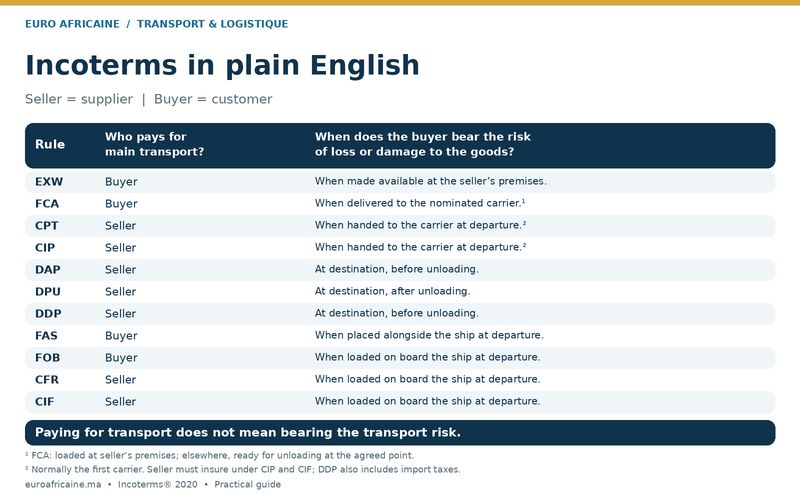
Incoterms 2020 fall into two groups.
- Seven rules for any mode of transport (sea, air, road, rail or multimodal), namely EXW, FCA, CPT, CIP, DAP, DPU and DDP.
- Four rules for sea and inland waterway transport only, namely FAS, FOB, CFR and CIF.
Using a sea rule for an air shipment is one of the most frequent errors.
EXW (Ex Works)
Under EXW Incoterms, the seller simply has the goods ready at its factory or warehouse and does not load them. The buyer is responsible for everything else, from loading and export clearance to main carriage and import clearance. The rule does not require insurance, so taking out cover is the buyer’s decision. Risk passes to the buyer as soon as the goods are placed at its disposal.
An EXW price includes fewer logistics services, leaving the buyer to arrange collection, loading, export clearance and onward transport. Export clearance can be difficult for a foreign buyer to arrange in the seller’s country, which often makes FCA a more practical choice.
FCA (Free Carrier)
With FCA Incoterms, the seller clears the goods for export and delivers them to the carrier nominated by the buyer at the agreed place, whether its own premises, a warehouse or a terminal. If delivery takes place at the seller’s premises, the seller loads the goods. At any other place, the seller brings them there ready for unloading but does not unload them. Risk passes to the buyer at that point.
FCA works for every mode of transport. Importers use it to arrange their own carriage while leaving export formalities to the supplier. Exporters often choose FCA when they want risk to transfer upon delivery to the buyer’s nominated carrier, while remaining responsible for their other contractual obligations. For containerised cargo, it reflects actual practice better than FOB.
Ex Works vs FCA: The difference lies in who loads the goods and who clears them for export. Under EXW, the buyer does both. Under FCA, the seller clears the goods for export and, if delivery is at its premises, also loads them. For most international sales, FCA avoids the practical difficulties that EXW can create.
CPT (Carriage Paid To)
The CPT Incoterm requires the seller to pay for main carriage to the agreed destination. Risk, however, passes to the buyer when the goods are handed to the first carrier in the country of departure. The place up to which the seller pays for carriage is therefore not the place where risk transfers. This transfer does not release the seller from its other obligations, such as contracting for carriage and providing the agreed documents.
CPT is often used by exporters who want to quote a price that includes transport to the agreed place, without bearing the risk during the journey. The buyer would be well advised to insure the goods, even though the rule does not require it.
CIP (Carriage and Insurance Paid To)
The CIP Incoterm follows the same logic as CPT, but the seller must also take out insurance for the buyer’s benefit. Since 2020, this cover defaults to Clauses (A), for at least 110% of the contract price. Even “all risks” cover has exclusions, notably for delay, inherent vice of the goods or, depending on the policy terms, insufficient packing.
It is well suited to air or multimodal shipments when the buyer wants broad cover without arranging it themselves.
DAP (Delivered at Place)
With the DAP Incoterm, the seller arranges carriage to the agreed place in the buyer’s country, such as the buyer’s warehouse. Delivery and transfer of risk take place on arrival, before unloading. The buyer therefore bears the risk of unloading, although unloading costs may be included in the carriage contract paid for by the seller. Import clearance, duties and taxes remain the buyer’s responsibility.
DAP is widely used in international road freight. For importers, it keeps logistics simple while leaving them in control of their customs declaration.
DPU (Delivered at Place Unloaded)
This is the only rule that requires the seller to unload the goods at destination. The seller must arrange unloading at the agreed place, and risk passes to the buyer once the goods have been unloaded. Import clearance remains the buyer’s responsibility.
It is best reserved for cases where the seller has access to suitable unloading equipment on site, heavy machinery delivered to a project site being a typical example.
DDP (Delivered Duty Paid)
DDP Incoterms place the greatest obligations on the seller. The seller delivers the goods to the agreed place, cleared for import and ready for unloading, having arranged carriage, import formalities and payment of the duties and taxes due. As with DAP, delivery takes place before unloading. The buyer bears the risk of unloading, although the costs may be included in the carriage contract paid for by the seller.
DDP requires careful customs and tax planning. In some countries, a foreign seller cannot act as importer of record and must use a representative. Whether the seller can recover import VAT depends on its tax position in the destination country. On the buyer’s side, liability in the event of a customs reassessment depends on who is shown as importer on the declaration, the type of representation and local law. Before offering or accepting DDP, check that it is workable from both a customs and a tax perspective.
FAS (Free Alongside Ship)
The seller clears the goods for export and places them alongside the vessel, on the quay at the port of loading. Risk passes to the buyer at that point.
FAS suits bulk and out-of-gauge cargo such as grain, scrap metal or heavy lifts. It is generally unsuitable for containers, which are handed over at the terminal well before they would be placed alongside the vessel.
FOB (Free On Board)
Under the FOB Incoterm, the seller clears the goods for export and loads them on board the vessel nominated by the buyer. Once the goods are on board, the buyer bears the risk and pays for the sea freight and the charges at the port of discharge. Insurance is the buyer’s choice.
FOB is very common for sea imports. The buyer chooses the shipping line and its own provider, but should request a detailed quote to know the arrival charges in advance.
The mistake to avoid: FOB is a sea rule. Using it for air freight makes no sense, as no vessel is involved. Even for sea shipments, containers are usually delivered to the terminal several days before loading. The seller then has no control over the goods but still bears the risk until they are on board. For containers, the ICC recommends FCA.
CFR (Cost and Freight)
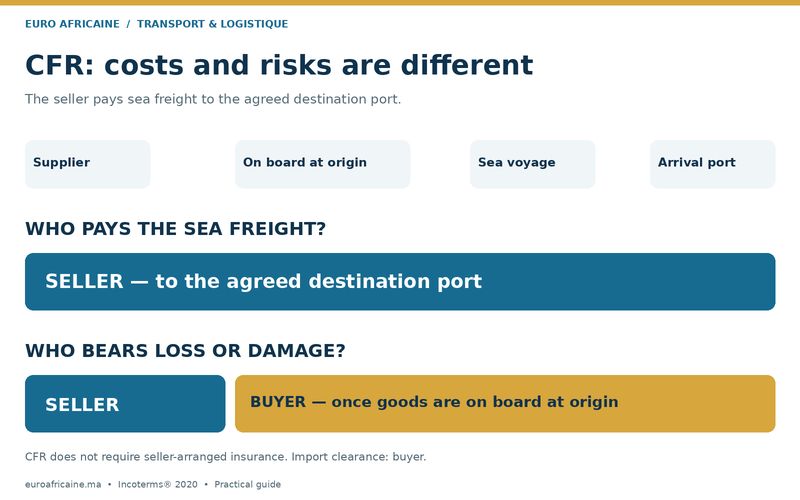
Under a CFR Incoterm contract, the seller pays the freight to the port of destination, but risk passes to the buyer once the goods are loaded on board at the port of departure. Who pays the charges at the destination port depends on what the seller’s carriage contract includes. Check in particular whether unloading and terminal handling at destination are covered by the freight paid by the seller, and which charges you will need to pay.
This is the rule from our opening example. Before accepting CFR, ask the carrier’s agent for a breakdown of arrival charges and consider insuring the cargo. The rule does not require it, but you bear the risk throughout the sea voyage.
CIF (Cost, Insurance and Freight)
The CIF Incoterm works in the same way as CFR, except that the seller must also take out insurance. The minimum required is Clauses (C), which mainly cover major events such as sinking, stranding or fire. Breakage or theft is only covered if the policy includes it or an extension is added.
CIF is common in practice. The seller arranges the main carriage, so if you want a specific shipping line or route, have it written into the contract before the sale is concluded. Always check the insurance by asking for the certificate, the insured amount and the clauses covered. In many countries, the CIF value is also the starting point for calculating customs duties, as explained below.
Incoterms comparison table
Swipe the table to the right to see all columns.
| Incoterm | Mode | Main carriage paid by | Insurance | Export clearance | Import clearance | Transfer of risk |
|---|---|---|---|---|---|---|
| Rules for any mode of transport | ||||||
| EXW | Any | Buyer | Optional, recommended for the buyer | Buyer | Buyer | Goods placed at the buyer’s disposal at the agreed point, not loaded |
| FCA | Any | Buyer | Optional, recommended for the buyer | Seller | Buyer | Delivery to the buyer’s nominated carrier or person at the agreed point* |
| CPT | Any | Seller | Optional, recommended for the buyer | Seller | Buyer | Delivery to the carrier at the agreed point, normally the first carrier |
| CIP | Any | Seller | Seller must insure, Clauses (A) by default | Seller | Buyer | Delivery to the carrier at the agreed point, normally the first carrier |
| DAP | Any | Seller | Optional, recommended for the seller | Seller | Buyer | At destination, on the arriving means of transport, before unloading |
| DPU | Any | Seller | Optional, recommended for the seller | Seller | Buyer | At destination, after unloading |
| DDP | Any | Seller | Optional, recommended for the seller | Seller | Seller | At destination, cleared for import, before unloading |
| Rules for sea and inland waterway transport only | ||||||
| FAS | Sea | Buyer | Optional, recommended for the buyer | Seller | Buyer | Alongside the buyer’s nominated vessel at the port of loading |
| FOB | Sea | Buyer | Optional, recommended for the buyer | Seller | Buyer | On board the buyer’s nominated vessel at the port of loading |
| CFR | Sea | Seller | Optional, recommended for the buyer | Seller | Buyer | On board the vessel at the port of loading |
| CIF | Sea | Seller | Seller must insure, minimum Clauses (C) | Seller | Buyer | On board the vessel at the port of loading |
Only CIP and CIF require the seller to arrange insurance. Under the other rules, insurance is optional and recommended for the party bearing the transport risk.
* Under FCA, the seller loads the goods when delivery takes place at its premises. At another agreed place, the goods are delivered on the seller’s arriving vehicle, ready for unloading.
Incoterms calculation, a worked example
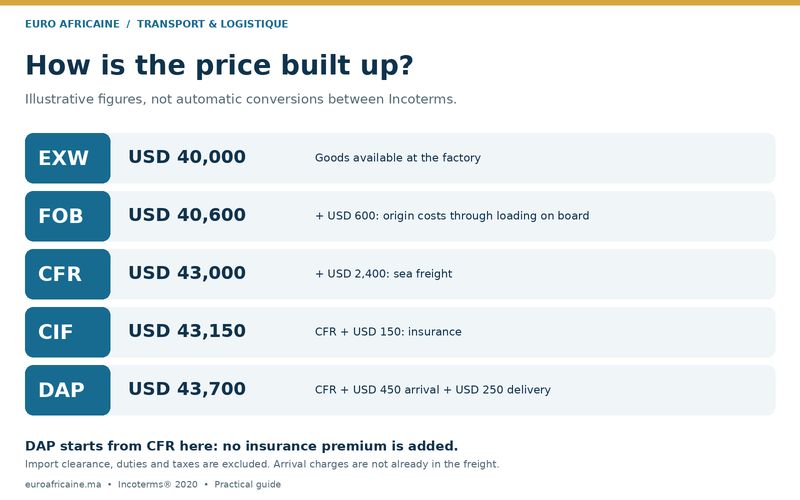
Take a 20-foot container of goods bought from an overseas manufacturer and delivered to the buyer’s warehouse. The figures are illustrative assumptions, not automatic conversions between Incoterms, and a real offer may differ. The example uses sea rules, which are still common in supplier offers, even though FCA, CPT or CIP are better suited to a container handed over at the terminal before loading. Actual rates vary with the season, the ports and the cargo.
EXW price, USD 40,000: The goods collected at the factory, with no logistics costs included.
Moving to FOB, + USD 600, giving USD 40,600. This covers loading, transport to the port of loading, export clearance and terminal handling until the goods are on board.
Moving to CFR, + USD 2,400 of sea freight, giving USD 43,000. The freight covers the voyage to the port of destination.
Moving to CIF, + USD 150 of insurance, giving USD 43,150. The premium used in this example is a small fraction of the insured value.
Moving to DAP buyer’s warehouse, USD 43,000 + USD 450 of destination port charges + USD 250 for delivery to the warehouse = USD 43,700. In this scenario, the USD 450 is not already included in the sea freight. The calculation starts from CFR rather than CIF because DAP does not require insurance, and no premium is added here. Import formalities, duties and taxes remain the buyer’s responsibility.
Customs value, often based on CIF
In many countries, including Morocco and EU member states, the customs value generally includes freight and insurance up to the point of entry, in line with the applicable valuation rules and regardless of the Incoterm in the contract. Buying on EXW or FOB terms therefore does not reduce the duty base. Import VAT is then calculated on a separate base, which usually adds customs duty to the customs value.
For this tax calculation, let us return to the CIF purchase at USD 43,150. With 10% customs duty and 20% import VAT, in this simplified example that excludes other taxes and possible adjustments, the figures are as follows.
- Customs value used in this simplified example: USD 43,150
- Customs duty at 10%: USD 4,315 (the actual rate depends on the HS code and the country)
- Import VAT at 20%: 47,465 × 20% = USD 9,493. This example does not include other items that may form part of the taxable base in some countries.
Some countries apply additional import taxes. Landed cost covers the goods, logistics to the warehouse, customs duties and any unexpected charges such as storage or demurrage. Import VAT is not part of it when it can be recovered, but it still increases the amount you need to finance. Depending on the country and the scheme, it is paid at clearance or accounted for in the VAT return. The exact rate for your product can be checked against its HS code with the customs authority of the importing country, for example using the ADiL simulator of Moroccan Customs.
Which Incoterm should you choose?
The right rule depends on your position, your experience and the mode of transport.
When importing, favour FOB or FCA: You choose the shipping line, the route and your provider, negotiate the freight and can obtain a detailed quote for arrival charges before shipment. This helps you keep your landed cost under control. FOB suits bulk and conventional cargo, while FCA suits containers. For a practical case, see our guide to importing from China to Morocco.
When exporting, favour FCA or CPT: Under FCA, risk passes to your customer when the goods are delivered to the carrier or person they nominated, at the agreed point, without releasing you from your other contractual obligations. Under CPT, you can quote a price that includes carriage to the agreed destination, while risk transfers to the buyer when the goods are delivered to the carrier. If your customer requires insurance, switch to CIP.
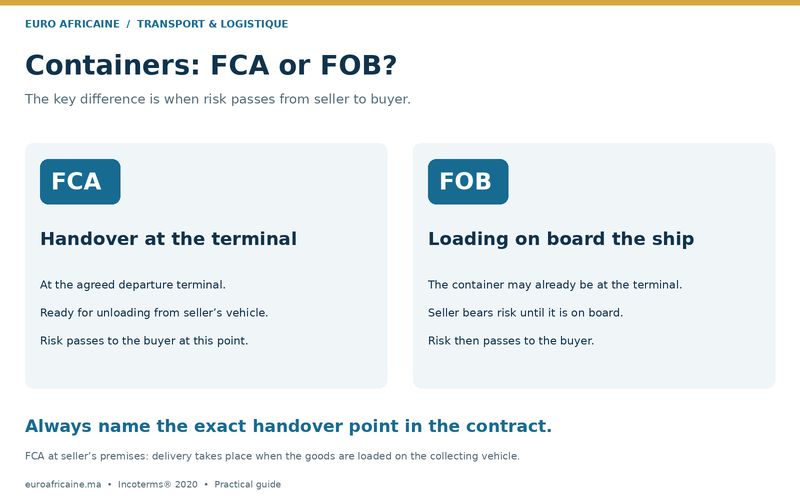
For containers, prefer FCA, CPT or CIP to the sea rules: For containerised shipments handed over before loading on board, consider FCA when the buyer arranges the main carriage, or CPT or CIP when the seller arranges and pays for it. Specify the delivery point carefully: under CPT and CIP, risk normally transfers when the goods are handed to the first carrier, which may occur before they reach the port terminal. When deciding between a full and a shared container, our comparison of FCL or LCL sets out the options.
For air and road: Use only the rules that apply to any mode, such as FCA, CPT, CIP or DAP. Our air freight and road freight pages explain the options for each case.
The 5 most common mistakes
- Using FOB for air freight: FOB is a sea rule. For air shipments, use a rule suitable for any mode, such as FCA, with a handover point that fits the operation, for example the air cargo agent’s warehouse.
- Accepting CIF without checking the insurance: Minimum cover does not always protect against breakage or theft. Ask for the insurance certificate, the clauses and the insured amount, or take out additional cover.
- Selling DDP without knowing local VAT and duties: Under DDP, the exporter pays the destination country’s import taxes. If these have not been costed, the margin can disappear, and the shipment may be held up if clearance proves impossible.
- Leaving the exact place out of the contract: A code followed only by a country name does not fix the delivery point, and therefore leaves the split of costs and risks unclear. You need a precise location, for example “FCA seller’s warehouse, full address” or “DAP buyer’s warehouse, full address”. The place determines who pays what and where risk passes.
- Not stating the edition: Always state the chosen edition after the code and the place, for example “FCA Yangshan Container Terminal, Shanghai, Incoterms® 2020”. Without it, a dispute may arise over which edition applies.
Conclusion
The Incoterm written into a contract determines who pays for each operation, when risk transfers and who handles customs formalities. It has a direct impact on your landed cost. To choose well, start from the mode of transport and from how much of the logistics you can manage yourself. FAS, FOB, CFR and CIF are reserved for sea and inland waterway transport, while the other seven rules apply to any mode.
Always calculate the total cost of delivery to the warehouse, bearing in mind that the customs value often includes freight and insurance. State a precise place and the chosen edition in the contract. Before signing, ask for a breakdown of destination charges as well. This quote helps you anticipate known costs, such as those that surprised our CFR buyer, and set aside a margin for storage or demurrage in case of delays.
Frequently asked questions about Incoterms
What are Incoterms in simple terms?
They are standard trade terms published by the ICC that tell the buyer and the seller who pays for each stage of transport, when the risk passes from one to the other and who handles customs. They only apply if the sales contract refers to them.
What is the difference between FOB and CIF?
Under FOB, the buyer pays the sea freight and decides whether to insure the cargo. Under CIF, the seller pays the freight and must take out the insurance required by the rule. In both cases, risk passes to the buyer when the goods are on board the vessel at the port of loading. CIF is simpler for the buyer, while FOB gives more control over costs.
FOB vs CPT, what is the difference?
FOB is a sea-only rule under which the buyer pays the main freight and risk passes once the goods are on board. CPT can be used for any mode. The seller pays the main carriage to the agreed destination, but risk passes earlier, when the goods are handed to the first carrier. For containerised shipments, consider FCA if the buyer arranges the main carriage, or CPT if the seller arranges and pays for it. For air and road shipments, use a rule suitable for any mode of transport.
Are Incoterms mandatory?
No. Incoterms only apply when the sales contract refers to them. Without them, the allocation of costs and risks depends on the applicable law and the wording of the contract, which increases the risk of disputes. They are widely used in international trade.
Which Incoterm protects the buyer most?
No single rule suits every buyer. DDP places the most obligations on the seller, including arranging import clearance, but the buyer should still check who will be the importer of record and which documents it will receive. DAP leaves the risk with the seller up to the agreed place, while the buyer keeps control of customs clearance. FCA or FOB allow the buyer to organise the main carriage, and suitable insurance is recommended for the risks it bears. The right choice depends on what you want to control.
How do you calculate a CIF price?
The CIF price is the FOB price plus sea freight to the port of destination and the insurance premium. The insured amount is normally at least 110% of the contract price, while the premium depends on the insurer’s rate and the cover chosen. For example, USD 40,600 (FOB) + USD 2,400 (freight) + USD 150 (insurance) = USD 43,150 CIF.
What is the latest edition of Incoterms?
The current edition is Incoterms® 2020, in force since 1 January 2020. There are no Incoterms 2024 and no interim edition. The ICC has started work on the next revision, with no official publication date announced. The parties may also agree on an earlier edition. In every case, state the chosen edition in the contract, together with the code and the exact place.
EURO AFRICAINE helps you choose the right Incoterm
The Incoterm is best decided before the order is placed. At EURO AFRICAINE Transport et Logistique, we support importers and exporters across Morocco and internationally. We review supplier offers, compare costs under each Incoterm, arrange sea freight, air or road transport, and follow your shipment through to delivery.
Send us details of your project (product, volume, origin or destination and proposed Incoterm) and we will reply with a full cost breakdown. Request a quote